
Researchers at BRIC, the University of Copenhagen, have discovered that the human body can create its own vaccine, which boosts the immune system and helps prevent chronic inflammatory diseases. The researchers’ results have just been published in the prestigious Journal of Clinical Investigation and may have significant consequences in developing new medicine.
Researchers at the Biotech Research and Innovation Centre (BRIC) at the University of Copenhagen have discovered a protein normally found in the body that can act to prevent chronic tissue inflammation. When administered in the form of a therapeutic vaccine it is able to effectively prevent and treat a number of different inflammatory disease models for multiple sclerosis (MS), rheumatoid arthritis (RA), skin hypersensitivity and allergic asthma (AA).
The results of this study have just been published by the prestigious Journal of Clinical Investigation in the article entitled “Endogenous collagen peptide activation of CD1d-restricted NKT cells ameliorates multiple tissue-specific inflammation in mice”.
Translational collaboration
The study was led by Principal Investigator Shohreh Issazadeh-Navikas, group leader for Neuroinflammation Unit at BRIC, and was the result of a translational collaboration involving researchers in Denmark, Sweden and Germany. The article culminates a decade’s long search for ways to combat inflammation and inflammatory diseases.
“The implications of the findings are large as they shed light on an important way that the body combats inflammation and autoimmunity. Moreover, they establish a therapeutic approach for using the newly discovered protein as a treatment for multiple conditions,” says Shohreh Issazadeh-Navikas.
Many inflammatory and autoimmune diseases are chronic and affect a large majority of people. Moreover, there is an inflammatory component to many common diseases, such as Alzheimer’s, Parkinson’s, RA, AA, MS, type II diabetes and cancers. The vaccine discovered by the researchers boosts special cells of the immune system, called NKT cells.
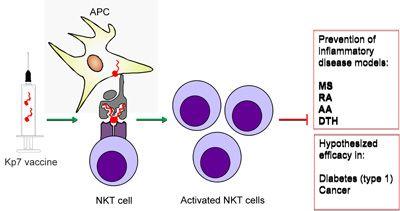
NKT cells are a type of T cell that exert profound and diverse regulatory effects in disease, from autoimmunity to responses to pathogens and cancer. For over two decades since their discovery NKT cells have traditionally been considered to be activated by lipid antigens presented by CD1 molecules. However, Professor Issazadeh-Navikas’ group was able to show for the first time the ability of a self peptide to activate NKT cells to suppress many tissue-specific inflammatory conditions including experimental autoimmune diseases.
Data offer new perspective
This highly significant and novel finding offers a new perspective on the ways in which the body combats inflammation in both health and disease. In addition, the researchers identified the activation requirements and signaling pathway through which they exert their function.
Professor Issazadeh-Navikas highlights, “Our data offer a novel perspective on the physiological role of these cells in maintenance of tissue homeostasis and reduction of inflammation.”
The findings significantly advance the fields of autoimmunity, antigen presentation, and NKT cells. They provide mechanistic insight into the biology of these cells and their roles in disease and point the way to therapies to treat many of the common conditions of mankind.
###
Professor Shohreh Issazadeh-Navikas, PhD, Group leader for Neuroinflammation Unit, BRIC
Telephone: +45 35 32 56 49
Mobile: +46 760 220 649
E-mail: shohreh.issazadeh@bric.ku.dk